The Restoring Force
Hooke’s Law and the Birth of the Science of Materials
0.1 Galileo at Padua
In the winter of 1638, Galileo Galilei sat under house arrest in Arcetri, half-blind, forbidden from publishing, and composed one of the most consequential works in the history of engineering. He was seventy-four years old. The book was called Discorsi e Dimostrazioni Matematiche intorno a Due Nuove Scienze — Discourses and Mathematical Demonstrations Relating to Two New Sciences — and it contained, buried in its second day’s dialogue, the first serious mathematical attempt to understand why structures break.
Galileo had watched beams fail. He had seen the workmen in the Venetian Arsenal snap oars and crack spars, and he understood intuitively that a longer beam required a thicker cross-section to carry the same load. This was ancient practical knowledge. What Galileo wanted was a reason — a mathematical account that would let an engineer calculate, not merely estimate. He chose the cantilever beam as his test case: a horizontal rod fixed at one end, loaded at the other, and threatening to snap at the wall.
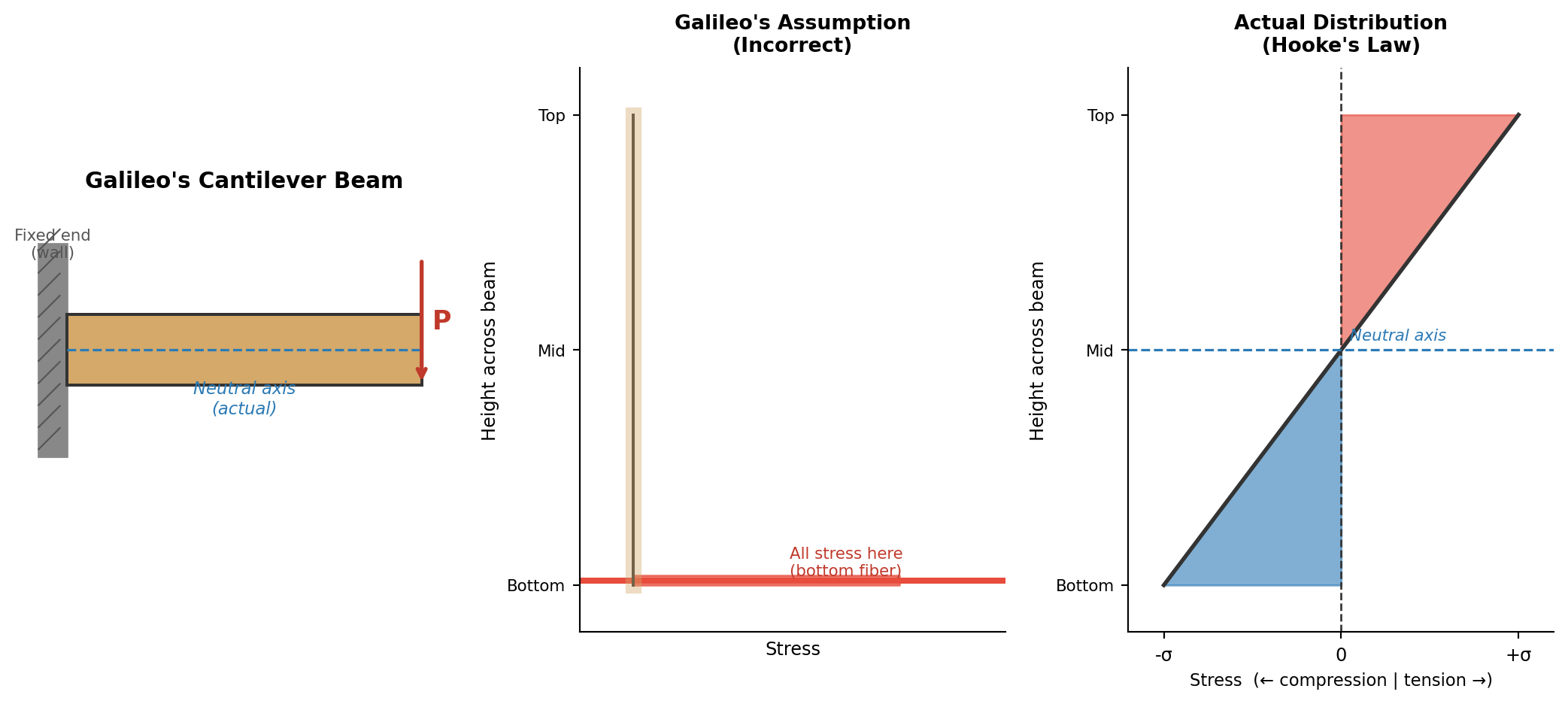
The picture he drew was right. He understood that the beam’s outer fibers — the ones farthest from the neutral axis — were being stretched on the top and compressed on the bottom (for a downward load). He correctly identified the fixed end as the location of maximum stress. These insights were not trivial. They had eluded mathematicians for centuries, and they remain the foundation of every structural analysis performed today.
But Galileo got the stress distribution wrong, and the error was not a small one. He assumed that all of the tensile resistance was concentrated at the bottom fiber of the beam — the extreme edge — rather than distributed across the cross-section in proportion to distance from the neutral axis. In modern language, he placed the neutral axis at the bottom of the beam instead of at its centroid. The consequence was that his formula for the breaking load was off by a factor of three, though in the wrong direction: he overestimated the strength of beams, which is a particularly dangerous mistake for an engineer to make.
0.2 The Problem Galileo Was Solving
To appreciate what Galileo was attempting, it helps to understand the practical stakes. The seventeenth century was building at a scale that previous generations had not attempted. Fortifications were growing larger. Ships were growing heavier. The cannon — that indiscriminate destroyer of both armies and the cannons themselves, which had an unfortunate habit of bursting at the breech — was demanding materials analysis that nobody knew how to provide.
When a cannon burst, or a deck beam broke, or a masonry arch collapsed, the engineers responsible had no theory to consult. They had rules of thumb — accumulated through generations of trial and considerable error — but they had no principled account of why things broke or how to predict whether a given design would fail. Stronger materials helped, but the margin between strong enough and catastrophically weak was a matter of experience, not calculation.
Galileo saw this problem clearly. A larger ship needed larger timbers, but in what proportion? If you doubled the length of a beam, did you double its cross-section or quadruple it? The answer depended on the relationship between load, geometry, and material strength, and in 1638 nobody had that relationship in mathematical form.
His approach was characteristically bold. He treated the beam as a lever, with the fulcrum at the base of the fixed end, and the tensile force in the beam’s material acting as the resistance arm. The geometry was compelling and not entirely wrong. The problem was that his fulcrum assumption predetermined the stress distribution, and the stress distribution he assumed bore no resemblance to the actual distribution that a material obeying Hooke’s Law would produce.
0.3 What Was Missing
The failure in Galileo’s analysis was not a mathematical error. The algebra was sound. The failure was conceptual: he had no law relating the deformation of a material to the force applied to it.
Without such a law, he could not determine how the internal stresses were distributed across the cross-section of a beam. He knew that the beam resisted the load somehow, but he could not say where — inside the material, distributed across the fibers — the resistance resided. His guess, placing all resistance at the outermost fiber, was the simplest possible assumption. It was also, as we now know, incorrect by a significant margin.
This missing piece was not obscure. It was simply unknown. No one, in 1638, had a quantitative description of how materials deform under load. Springs were known to be elastic — they returned to their original shape — but the relationship between the force applied and the amount of deformation had not been measured, stated, or used in calculation. The very concept of a material property relating force to deformation did not yet exist.
Galileo was, in a sense, trying to solve a problem whose key ingredient had not yet been discovered. It is the intellectual equivalent of deriving the pressure in a gas before anyone had stated the ideal gas law: the framework is there, the reasoning is there, but the crucial proportionality is absent.
0.4 Mariotte and the Missing Step
In 1680, four decades after Galileo and two years after Hooke, the French physicist Edme Mariotte published Traité du Mouvement des Eaux et des Autres Corps Fluides, which contained, almost incidentally, a correction to Galileo’s beam analysis. Mariotte realized that the neutral axis of a bent beam lies at its centroid — the geometric center — not at its bottom edge. His physical intuition was better: he recognized that fibers above the neutral axis are in tension and fibers below are in compression, and that neither tension nor compression is uniformly distributed but varies linearly across the cross-section.
Mariotte was right about the neutral axis. But he was still working without Hooke’s Law, which meant he was working without a rigorous foundation for the linear stress distribution he was assuming. He arrived at the correct qualitative picture through physical intuition. The mathematical confirmation — the proof that an elastic material following Hooke’s Law must produce a linear stress distribution across a bent beam — would come a century later, after the law had been discovered, named, and gradually extended from springs to solids.
The lesson of this interlude is important. In the seventeenth century, there were brilliant people trying to do structural mechanics. Galileo, Mariotte, Christiaan Huygens, and others were attacking these problems with considerable sophistication. What stopped them was not a failure of intelligence or method. It was the absence of a physical law that no one had yet stated.
That law was being worked out, at almost exactly this moment, in a cluttered London laboratory by a man with a curved spine and a bottomless grudge against Isaac Newton.
0.5 Why the Law Had to Come First
There is a lesson in Galileo’s partial success that runs through the entire history of engineering science. Mathematical frameworks can be erected before their foundations are complete, and they often are — because the problems are pressing and the people are clever. But structures built on incomplete foundations eventually require reconstruction. The history of beam theory is a long process of reconstruction: Galileo’s formula, then Mariotte’s correction, then the full Euler-Bernoulli theory, then the refinements of Timoshenko for thick beams, then the computational methods of finite element analysis. Each step added a piece that the previous step had approximated or guessed.
The piece that triggered the whole sequence of improvements was a simple observation about springs: that the force required to stretch a spring is proportional to how much you stretch it. No more, no less. A proportionality so obvious, once you measure it, that it seems almost too simple to have been a discovery.
It was a discovery. It had a discoverer. And he went to considerable trouble to keep it secret.