4 From Spring to Stuff
4.1 The Problem with Springs
Hooke’s Law, in its original form, is a statement about springs. A spring has a spring constant, \(k\), and the force required to stretch it by a distance \(x\) is \(F = kx\). The law is precise, experimentally robust, and genuinely useful for analyzing anything that behaves like a spring.
But springs are peculiar objects. Their stiffness depends not only on the material they are made from but on their geometry: the wire diameter, the coil diameter, the number of turns. Two springs made from exactly the same grade of steel — the same atoms, arranged in the same crystal structure, with the same composition and heat treatment — can have spring constants that differ by a factor of a hundred, simply because one is wound tightly and the other loosely. This means that \(k\), as Hooke defined it, is not a property of the steel. It is a property of the spring.
This is a problem if you want to compare materials. If you are trying to decide whether to build a bridge from iron or from oak — a genuinely practical question in the eighteenth century — you cannot compare their spring constants, because the spring constants depend on what shape you have made the material into. You need a property that belongs to the material itself, stripped of the geometry of the object. You need, in the vocabulary that would eventually emerge, a material property rather than a structural property.
The person who saw this distinction clearly, who named the required property and gave it a definition rigorous enough to be used in calculation, was Thomas Young, in a series of lectures delivered at the Royal Institution in London beginning in 1801 and published in 1807.
4.2 Thomas Young, Polymath
Thomas Young was the sort of person who makes everyone else feel inadequate. He had learned to read by the age of two, and had read through the Bible twice by the time he was four. At the age of fourteen he was studying ten languages; he eventually became fluent in a dozen, including classical Greek, Hebrew, Persian, and Arabic. As a young physician in London, he wrote papers on the theory of the eye and color perception — laying groundwork for what we now call the trichromatic theory of color vision — while maintaining a medical practice. He made significant contributions to the understanding of light’s wave nature, conducting the double-slit interference experiment that remains a fixture of every introductory physics course. And when the Rosetta Stone arrived in London in 1802, it was Young who made the first significant progress in deciphering Egyptian hieroglyphics, correctly identifying several of the phonetic characters.
In the interstices of all this, he gave lectures at the Royal Institution on natural philosophy and delivered, almost in passing, the definition of what we now call Young’s Modulus.
Young was not a man of elegant self-promotion. His scientific papers were frequently too compressed for other readers to follow, and his lectures, according to contemporaries, were delivered at a speed and density that left audiences behind. He was brilliant in a way that outran communication — a recurring problem in the history of science, and one that has cost more than a few discoverers the credit they deserved. Young’s contribution to elasticity theory was largely absorbed and clarified by French mathematicians over the following decade, and the modulus that bears his name was established in textbooks through the work of others as much as his own.
None of which diminishes the insight. The insight was real, it was important, and it was Young’s.
4.3 Normalizing Away the Geometry
Young’s key move was to recognize that if you want to compare materials, you need to normalize out the effects of size.
Consider two rods made from the same steel. One is long and thin; one is short and fat. If you apply the same force to each, the long thin rod stretches more than the short fat one. This is not because the material is different. It is because the geometry is different. A longer rod has more material to contribute to the elongation; a thinner rod has less cross-sectional area to distribute the load across.
To make a fair comparison, Young argued, you need to express the load in terms of force per unit area — how much force is carried by each square meter of cross-section — and you need to express the deformation in terms of elongation per unit original length — what fraction of its original length the material has stretched. These two quantities are independent of the size and shape of the sample. They are properties of the material’s response to loading, not properties of the particular rod or bar being tested.
The first of these quantities is now called stress, denoted by the Greek letter sigma, \(\sigma\). For a rod of cross-sectional area \(A\) carrying a load \(F\) in tension, the stress is:
\[\sigma = \frac{F}{A} \tag{4.1}\]
Stress is force divided by area, measured in Pascals, where one Pascal equals one Newton per square meter. When you press your thumb against a table, the table exerts a stress on your thumb that equals the force you are pushing with divided by the area of contact. A sharp thumbtack and a blunt thumb can exert the same total force; the tack concentrates that force onto a tiny area, producing a far higher stress — which is why the tack can penetrate the table and the thumb cannot.
The second quantity is called strain, denoted by the Greek letter epsilon, \(\varepsilon\). For a rod of original length \(L\) that has stretched by an amount \(\Delta L\) under load, the strain is:
\[\varepsilon = \frac{\Delta L}{L} \tag{4.2}\]
Strain is dimensionless — it is a ratio of two lengths, so its units cancel. A steel rod that stretches by one millimeter from an original length of one meter has a strain of 0.001. A rubber band that stretches by ten centimeters from an original length of ten centimeters has a strain of 1.0. The numbers are directly comparable because they have been normalized to the original length.
Now Hooke’s Law can be restated in terms of these normalized quantities. If force is proportional to extension — Hooke’s original statement — then force per unit area is proportional to extension per unit length. In symbols:
\[\sigma = E\varepsilon \tag{4.3}\]
This equation is sometimes called Young’s Law or, in older literature, the law of elasticity. The constant of proportionality \(E\) is called the modulus of elasticity or, most commonly, Young’s Modulus. It is measured in Pascals, the same units as stress, because strain is dimensionless. Its value depends only on the material, not on the geometry of the sample.
4.4 Reading the Numbers
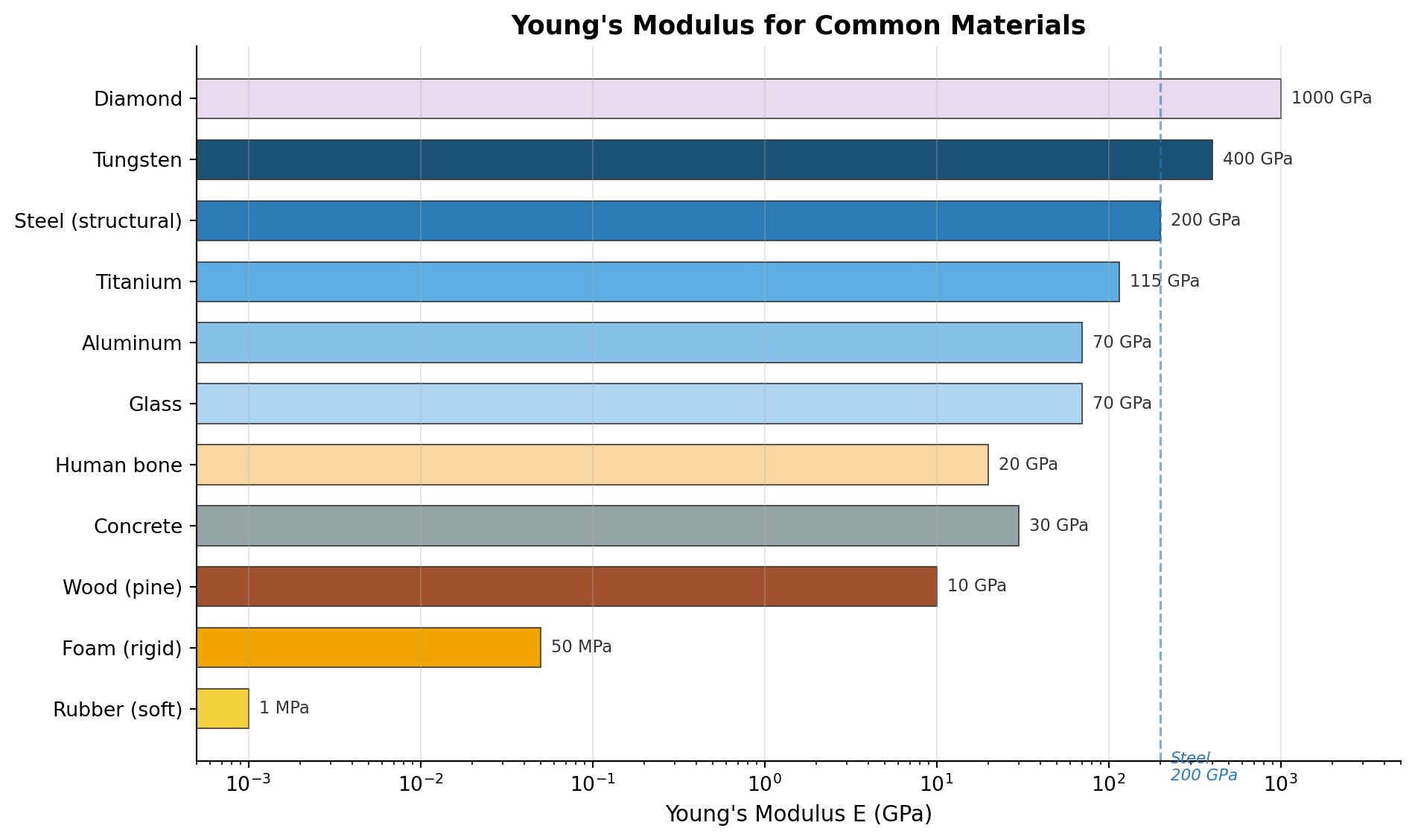
The chart above conveys, in a single image, the range of elastic behavior that engineers must navigate. Rubber, at one end of the scale, has a Young’s Modulus near one megapascal — it takes only about one Newton applied over a square meter to produce a one-percent strain. Diamond, at the other end, has a modulus around a thousand gigapascals — one terapascal — and is so stiff that the strains produced by any practically achievable load are nearly unmeasurable.
Structural steel, at around 200 gigapascals, sits in a regime that engineers have been exploiting for a century and a half. This value means that applying a stress of 200 megapascals — about 200 million Newtons per square meter, a very high load for most applications — produces a strain of exactly one tenth of one percent. The steel has stretched by one millimeter per meter of original length. At this level of loading, the steel is still entirely elastic: release the load, and it springs back exactly to its original length. Hooke’s Law holds precisely.
Human cortical bone, the dense outer shell of your femur and tibia, has a modulus around 20 gigapascals in the longitudinal direction. This is one-tenth the stiffness of steel, which means bone deforms ten times more under the same stress — but it is still far stiffer than most people intuitively expect. Bone is not soft. It is a remarkable composite material, and the reason your skeleton does not deflect visibly under your body weight is that its Young’s Modulus is high enough to produce strains that are mechanically significant but geometrically imperceptible.
4.5 The Spring Constant Revisited
Young’s formulation connects back to Hooke’s original spring constant in a satisfying way. For a rod of cross-sectional area \(A\), original length \(L\), and material modulus \(E\), the spring constant \(k\) that relates the total applied force \(F\) to the total elongation \(\Delta L\) is:
\[k = \frac{EA}{L} \tag{4.4}\]
This equation says that a rod is stiffer — has a higher spring constant — if it is made from a stiffer material (larger \(E\)), if it has a larger cross-section (larger \(A\)), or if it is shorter (smaller \(L\)). All three of these effects are intuitively correct and have been known empirically since antiquity. The equation quantifies them precisely and shows that they are all manifestations of the same underlying law.
A coil spring is more complicated than a straight rod — the wire is loaded in torsion rather than tension as the spring compresses or extends — but the same logic applies: the spring constant of a coil spring can be derived from the shear modulus of the wire material, the wire geometry, and the coil geometry. The material property (this time the shear modulus rather than Young’s Modulus) is at the foundation; the spring constant emerges from combining that material property with the geometry.
4.6 Why This Matters
Young’s reformulation of Hooke’s Law shifted the language of engineering from objects to materials. Before Young, engineers compared springs. After Young, engineers could compare steels, and then compare steel to cast iron, to wrought iron, to bronze, to wood, to concrete. The modulus was something you could look up in a table, or measure in a laboratory on a small sample, and then use to predict the behavior of a large structure made from the same material.
This was the intellectual prerequisite for the explosion of structural engineering that followed the industrial revolution. The great iron bridges of the nineteenth century — Telford’s Menai Suspension Bridge, Brunel’s Clifton Suspension Bridge, the railway viaducts of the Victorian era — were all designed using methods that depended, at their foundation, on knowing the Young’s Modulus of the iron in question. The modulus was measured; the allowable stress was specified; the required cross-sections were calculated. This is modern structural engineering, and it traces directly to Young’s 1807 reformulation of what Hooke had observed in 1678.
But Young’s formulation, powerful as it was, addressed only one dimension. A rod pulled in tension is a clean one-dimensional problem: one stress, one strain, one modulus. Real structures experience loads in multiple directions simultaneously. A column carries compression while also bending. A vessel wall carries tension in two perpendicular directions at once. The full mathematical description of how a material responds to three-dimensional loading — the extension of Hooke’s Law into the full richness of the solid material world — was accomplished by a French mathematician in the 1820s, and it required the invention of a new mathematical object to express what the material was actually doing.