7 Where Hooke Lies
7.1 A Material’s Biography
When a metallurgist wants to understand a material, the first thing she does is pull it apart. Not carelessly — the pulling is controlled, the force is measured continuously, and the extension is recorded at every moment. The result is a curve of stress versus strain that begins with a straight line and ends, eventually, in fracture. This curve is a biography of the material’s elastic and plastic life. Everything Hooke’s Law can explain appears in the first part of the curve. Everything else appears after.
The stress-strain test is performed in a tensile testing machine: a device that grips a precisely machined sample at both ends and pulls them apart at a controlled rate, measuring the force required at every instant. The sample — typically a round bar or a flat coupon with a reduced-gauge section — is machined to standard dimensions so that the test can be compared to results from other laboratories on other machines. The force is divided by the original cross-sectional area to give engineering stress; the extension is divided by the original gauge length to give engineering strain. The resulting curve is a material property, not a property of the sample’s dimensions.
7.2 The Five Territories
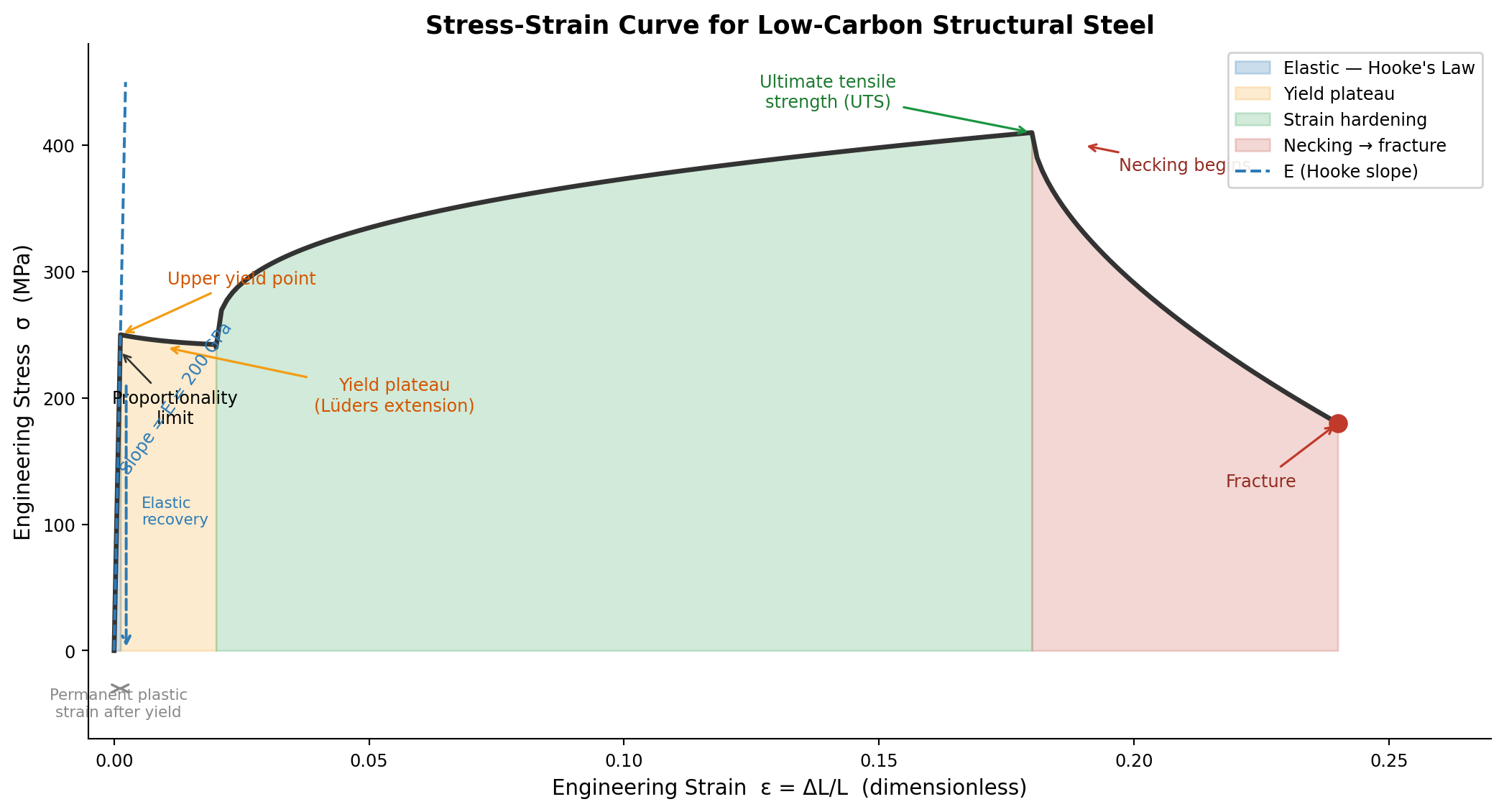
Steel — specifically a low-carbon structural steel, the workhorse of construction and the material that built the modern world — produces one of the more instructive stress-strain curves in engineering. It has five distinguishable regions, each governed by different physics.
The elastic region is where Hooke’s Law holds exactly. Stress is proportional to strain; the curve is a straight line with slope \(E\), Young’s Modulus. If you release the load at any point in this region, the material returns to exactly its original dimensions. The deformation is completely reversible. The steel remembers its unloaded shape as if the loading had never happened. For structural steel, the elastic region extends to stresses of roughly 250 megapascals — about 250 million Newtons per square meter. This seems like a large number until you realize that the weight of a modest building, spread over the structural columns, can approach such stresses at the base.
The proportionality limit is the stress at which the curve first deviates from a perfectly straight line. Below this stress, the proportionality between stress and strain is exact. Above it, the curve begins — very slightly — to bend. The deviation is often too small to detect without precise instrumentation, and for practical engineering the proportionality limit is frequently taken as coincident with the elastic limit.
The elastic limit is the stress above which the material will no longer return to its original dimensions when unloaded. Load the material beyond this point and release; the sample will be slightly longer than it was. This permanent elongation is called plastic strain, and the material has now been plastically deformed. The change is permanent. The steel has, in a colloquial sense, learned a new shape.
The yield point is where the curve takes a dramatic turn in low-carbon structural steel — a turn so dramatic that it caused early materials testers to suspect instrument malfunction. Above the yield point, the stress actually drops and then oscillates at roughly constant value while the strain continues to increase. The material is deforming plastically at nearly constant stress. This plateau is called the yield plateau or Lüders extension, and it can extend to strains several times the elastic-limit strain before strain hardening begins.
Strain hardening is the gradual stiffening that occurs as the material continues to be stretched beyond the yield plateau. The curve rises again, though less steeply than in the elastic region, as the material’s crystal structure becomes increasingly disrupted and further deformation requires increasing stress.
Ultimate tensile strength is the peak of the curve: the maximum stress the material can carry. Beyond this point, the sample begins to neck — a local region of the gauge section contracts more rapidly than the rest, concentrating deformation in a small zone. The engineering stress (calculated using the original area) falls after necking begins, even though the true stress in the necked region is still rising.
Fracture is the end. The necked region reaches its limit and separates. The pieces can be reassembled and examined; the fracture surface records a great deal about the mode and mechanism of failure.
7.3 What Happens Inside
The stress-strain curve describes behavior from the outside — force and displacement, stress and strain. But the physics happens inside the material, at the level of atoms and crystal defects, and understanding that level explains why the curve has the shape it does.
Metals are crystalline: the atoms are arranged in regular, repeating lattices. In the elastic region, stretching the metal means stretching the bonds between atoms. These bonds behave, to a good approximation, like Hooke’s Law springs: they resist deformation linearly and spring back completely when released. Young’s Modulus is, at its deepest level, a measure of the stiffness of interatomic bonds.
When the yield stress is reached, something different happens. Rather than stretching the bonds until they break — which would require much higher stresses — the atoms slide past each other along specific crystallographic planes. The mechanism is not a wholesale sliding of one plane over another, which would require simultaneously breaking all the bonds across the interface. It is instead carried by dislocations — line defects in the crystal structure at which the lattice is misaligned by one atomic spacing. A dislocation moves through the crystal like a wrinkle moving across a carpet: the wrinkle crosses the room with far less effort than dragging the whole carpet. Plastic deformation is dislocation motion, and the yield stress is the stress at which dislocations begin to move freely.
Strain hardening occurs because moving dislocations encounter other dislocations, grain boundaries, and precipitates, all of which impede further motion. As deformation continues, the dislocation density increases and the obstacles multiply, making further deformation progressively harder. The stress must rise to keep the dislocations moving. This is the rising portion of the curve after the yield plateau.
7.4 Griffith and the Crack
In 1920, an engineer at the Royal Aircraft Factory at Farnborough named A.A. Griffith set out to understand why glass fractures at stresses far below those that theoretical atomic bond strength would predict. Glass, calculated from the force required to separate two atomic planes, should be able to withstand stresses approaching ten gigapascals. In practice, glass fractures at stresses a hundredfold smaller. The discrepancy was enormous, and it was not explained by conventional strength-of-materials theory.
Griffith’s answer was the crack. Real materials contain cracks — tiny, often invisible, sometimes just a few atoms wide. These cracks do not simply weaken the material by reducing the load-bearing area. They do something far more destructive: they concentrate stress at their tips.
Hooke’s Law applied to the elastic field around a crack tip shows that the stress at the tip is theoretically infinite for a perfectly sharp crack — it diverges as \(1/\sqrt{r}\), where \(r\) is the distance from the tip. In practice, real cracks are not perfectly sharp at the atomic scale, and real materials are not perfectly brittle — some plastic deformation occurs at the tip, blunting it and limiting the stress concentration. But the stress at a crack tip is vastly larger than the nominal applied stress, and this concentration is what causes brittle fracture at loads far below theoretical strength.
Griffith’s formula for the stress required to propagate a crack of half-length \(a\) in a material with surface energy \(\gamma\) and modulus \(E\) is:
\[\sigma_f = \sqrt{\frac{2E\gamma}{\pi a}} \tag{7.1}\]
This equation predicts that fracture stress is inversely proportional to the square root of crack length. Double the crack length and you reduce the fracture stress by thirty percent. A crack one millimeter long reduces the fracture strength of glass by a factor of roughly thirty compared to its theoretical maximum. This is why glass is fragile: not because it is inherently weak, but because it is inherently cracked.
7.5 Where Hooke’s Law Is and Is Not
The honest summary: Hooke’s Law is correct for an enormous range of materials and conditions, and it is the foundation of structural design. But it has boundaries.
Metals obey Hooke’s Law up to their yield point — which, for structural steel, is a practical and useful range. Beyond yield, they deform permanently.
Ceramics (glass, concrete, stone) obey Hooke’s Law with high moduli but fracture with essentially no warning and no yielding — the stress-strain curve is a straight line that ends abruptly. Hooke’s Law describes them perfectly right up to the moment they shatter.
Polymers and rubber do not, in general, obey Hooke’s Law. Rubber can undergo strains of several hundred percent and still return to its original shape — but the force-extension curve is markedly nonlinear. Different frameworks are required, which we will touch on in the final chapter.
Biological tissues — tendon, muscle, skin, artery wall — are spectacularly nonlinear. A tendon stiffens dramatically as it is stretched: initially easy to extend, then progressively stiffer. This behavior, called toe-region nonlinearity, is caused by the progressive uncrimping of collagen fibers.
In all these cases, Hooke’s Law fails to capture the full picture. But it often captures the initial, small-deformation behavior accurately, and the small-deformation regime is where most engineering structures spend most of their lives. The law’s range of validity coincides, in most cases, with the regime of safe structural operation. To operate a structure in the regime where Hooke’s Law fails is, almost always, to operate it in a regime where it is about to fail.
That coincidence is not a coincidence at all. It is the reason we care about Hooke’s Law in the first place.