3 The Anagram and the Spring
3.1 A Difficult Man with a Difficult Life
Robert Hooke was, by nearly all accounts, not easy company. Contemporary descriptions portray a man lean to the point of emaciation, with a pronounced curvature of the spine — possibly scoliosis, possibly the result of childhood illness — and eyes that contemporaries described as grey, sharp, and probing. John Aubrey, who liked him, said his forehead was large and he had a quick, restless mind. Others were less charitable. He was suspicious of credit, litigious about priority, and carried grudges with the fidelity of a notary.
He was also, without serious competition, the most productive experimental scientist of the seventeenth century.
Hooke joined the Royal Society in 1660, shortly after its founding, and was appointed Curator of Experiments — meaning it was his job to design and conduct demonstrations at each meeting. The position was underpaid, occasionally humiliating, and required a weekly production of scientific novelty that would have broken most people. Hooke sustained it for decades. He invented or improved the balance spring for watches, the compound microscope (his Micrographia of 1665 is one of the great books in the history of science), the air pump, the wheel barometer, the iris diaphragm, and various other instruments whose names have been absorbed into the background of modern technology. He was the first person to observe plant cells under a microscope and to use the word “cell” to describe them.
None of this made him wealthy. Most of it made him resentful, because Robert Hooke’s second defining characteristic — after productivity — was his conviction that other people were taking credit for his ideas. In several notable cases, he was right.
3.2 The Longitude Problem
To understand why Hooke was working on springs in the 1660s and 1670s, you need to understand one of the great practical problems of the seventeenth century: longitude at sea.
Determining latitude — how far north or south you are — is relatively straightforward. Measure the angle of the sun at noon, or the North Star at night, and a table of values tells you where you stand. But longitude — how far east or west — requires knowing the exact time. The Earth rotates 360 degrees in 24 hours, which means it rotates 15 degrees per hour. If you know what time it is at a reference location (Greenwich, say) and you observe the local noon, the difference between those two times tells you your longitude directly. One hour of difference equals 15 degrees of longitude.
The problem was timekeeping. A clock that loses a few minutes per day on land is merely inconvenient. A clock that loses the same few minutes per day at sea will, over the course of a transatlantic voyage, accumulate enough error to place you a hundred miles from where you think you are. This was not a theoretical problem. Ships were regularly lost because navigators did not know their position.
Hooke believed that a watch regulated by a coiled spring — rather than by a pendulum, which is sensitive to the motion of a ship — could keep accurate enough time for longitude determination. This belief drove a great deal of his experimental work on springs. He was trying to understand how springs vibrate, how they age, how their restoring force behaves under repeated cycling. In the course of this practical investigation, he made the discovery that would outlast all of his other contributions.
3.3 The Anagram
In 1676, Hooke published a Latin pamphlet on helioscopes — devices for observing the sun — and appended to it, almost as a footnote, the following sequence of letters:
\[ceiiinosssttu\]
This was not a typographical error. It was an anagram, and it was Hooke’s deliberately obscure method of claiming priority for a discovery he was not yet ready to reveal. The convention was common enough in the seventeenth century: publish a scrambled version of your result so that, if someone else later announced the same discovery, you could unscramble your anagram and prove you had known it first. It was priority insurance with a secrecy premium.
The letters, rearranged, spell: ut tensio sic vis.
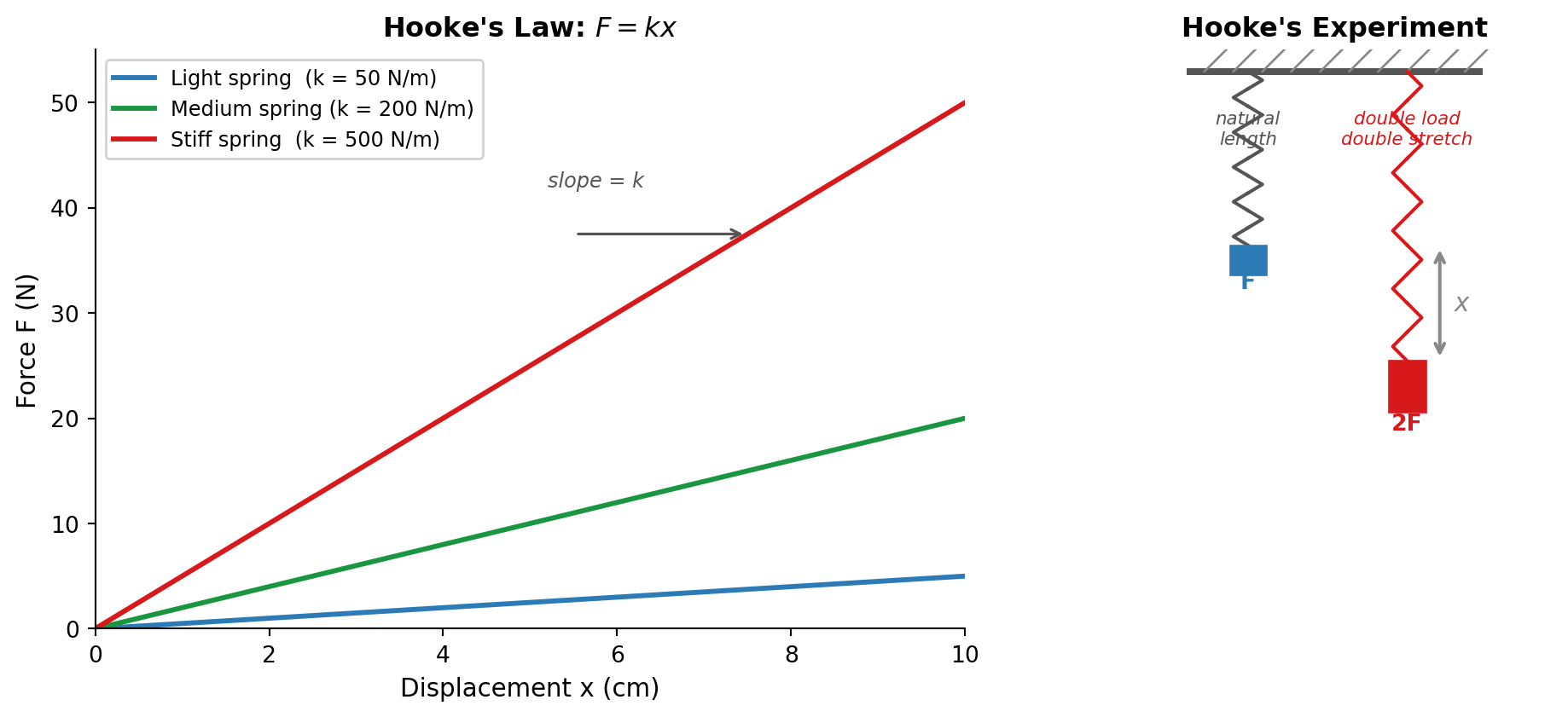
This is Latin for as the extension, so the force. Two years later, in 1678, Hooke published Lectures de Potentia Restitutiva, or Of Spring, which revealed the anagram and elaborated the law it encoded. The law, in his words: “The power of any spring is in the same proportion with the tension thereof.” Double the stretch, double the force. Halve the stretch, halve the force. The relationship is linear, and the constant of proportionality is a property of the spring.
3.4 The Experiment
Hooke’s experimental setup was elegant in its simplicity. He hung a spring vertically, attached a pan to its lower end, and added weights to the pan one at a time. For each weight added, he measured how much the spring stretched. He then plotted — either explicitly or in his head, the historical record is not entirely clear — the force against the extension.
The result was a straight line through the origin. This is what “linear” means: a constant ratio between cause and effect. Twice the weight, twice the extension. Three times the weight, three times the extension. The line does not curve. It does not accelerate. It goes straight, at least until the spring is overloaded and its behavior changes fundamentally — a complication that Hooke noted but set aside.
In the notation we use today, Hooke’s Law is written as:
\[F = kx \tag{3.1}\]
In this equation, \(F\) is the force applied to the spring, measured in Newtons. The letter \(x\) is the displacement of the spring from its natural, unloaded length — how much it has been stretched or compressed — measured in meters. And \(k\) is the spring constant, measured in Newtons per meter, a number that characterizes the stiffness of that particular spring.
The spring constant \(k\) carries all the information about the spring’s resistance to deformation. A stiff spring — a heavy-duty automobile suspension spring — has a large \(k\). A light spring — the kind that clicks your pen closed — has a small \(k\). The law itself says nothing about what \(k\) is; that depends on the material the spring is made of, how thick the wire is, how many coils it has, and how tightly they are wound. Different springs, different \(k\) values. Same law.
3.5 What the Spring Constant Means
The spring constant \(k\) is a number with a physical meaning: it tells you how many Newtons of force are required to stretch the spring by one meter. A spring with \(k = 100\) Newtons per meter requires 100 N to stretch it one meter, 50 N to stretch it half a meter, and 10 N to stretch it a tenth of a meter. The relationship is exact, not approximate, as long as the spring is not overloaded.
What determines \(k\)? For a coil spring, the answer involves the material’s resistance to twisting (what we now call the shear modulus), the wire diameter, the coil diameter, and the number of active coils. Change any of these, and you change \(k\). The law \(F = kx\) encapsulates all of this complexity into a single constant. This is one of the great virtues of Hooke’s formulation: it is exact for any spring regardless of its geometry, as long as you know its \(k\). The physics of why \(k\) has a particular value is a separate and more detailed question. The law itself says only that, whatever \(k\) is, the force and extension are proportional.
This separation — between the law’s structure and the specific material constants that feed into it — is characteristic of the best physical laws. Newton’s second law, \(F = ma\), has the same quality: the law itself says force is proportional to acceleration; the mass \(m\) is a property of the object that you measure separately. The structure and the parameters are cleanly divided.
3.6 The Newton Problem
Robert Hooke’s relationship with Isaac Newton was, to put it diplomatically, charged.
The conflict had many roots, but the most famous involved the inverse-square law of gravity. Hooke had, in 1679, written to Newton suggesting that orbital dynamics might follow an inverse-square relationship — that the gravitational force between two bodies might decrease as the square of the distance between them. Newton did not reply promptly. When he published his Principia Mathematica in 1687, which derived the orbits of planets from precisely this inverse-square law, Hooke erupted. He accused Newton of plagiarism, of using his ideas without credit. Newton, who had his own complex relationship with credit and with virtually everyone he worked with, denied any debt to Hooke and responded to the accusation with the implacable fury that he brought to most disputes.
The disagreement was never resolved. When Hooke died in 1703, Newton became President of the Royal Society. Shortly afterward, the only known portrait of Hooke — painted during his lifetime, the only image that might have shown us his face — disappeared. Whether Newton arranged its removal, or whether it simply vanished in the chaos of institutional transition, has never been established. What is established is that no authenticated portrait of Robert Hooke exists today.
For a man so concerned with priority and credit, this is a bitter irony. His name is on the law that underpins structural mechanics, seismology, watchmaking, and materials science. His face is unknown.
3.7 The Reach of a Simple Proportionality
In 1678, Hooke’s Law was a useful description of spring behavior and not much more. Hooke himself used it primarily to analyze the behavior of balance springs in watches — a practical engineering application, valuable but narrow. He understood that the law probably applied to other materials as well; he suggested as much in Lectures de Potentia Restitutiva, noting that the elastic properties of springs, arches, and bowed rods all followed the same proportion. But the systematic extension of the law from springs to solid materials — from \(F = kx\) to the relationship between stress and strain that governs the behavior of steel, concrete, glass, and bone — was the work of the following century, and it belongs principally to a man who read Hooke, understood him, and went considerably further.
That man could decode Egyptian hieroglyphics. He understood the wave theory of light well before it was accepted. He was a physician, a physicist, and a linguist. His name is not as famous as it should be, which is a persistent hazard in the history of science, and which we will address in the next chapter.