Describe common membership function shapes and when to use each
Apply the standard fuzzy set operations: union, intersection, complement
Define linguistic variables and understand their role in fuzzy systems
9.1 The Spectrum of Belonging
In classical set theory, an element either belongs to a set or it does not. In fuzzy set theory, proposed by Lotfi Zadeh in 1965, an element belongs to a set to a degree, expressed as a number in \([0, 1]\).
Formally, a fuzzy set \(A\) in a universe \(X\) is defined by a membership function:
\[\mu_A : X \to [0, 1] \tag{9.1}\]
For any element \(x \in X\), \(\mu_A(x) = 0\) means \(x\) is definitely not in \(A\); \(\mu_A(x) = 1\) means \(x\) is definitely in \(A\); and any value between means partial membership.
A classical (crisp) set is a special case: \(\mu_A(x) \in \{0, 1\}\) for all \(x\).
9.2 Membership Function Shapes
The membership function is a design choice. Several standard shapes recur throughout applications:
Triangular: rises linearly to a peak and falls linearly. Good for representing “approximately equal to a target value.”
Trapezoidal: flat at the top — a range of full membership before gradual fall-off at the edges.
Gaussian: smooth, symmetric bell curve. Natural when the concept has a central prototype and uncertainty increases with distance from it.
Sigmoid: S-shaped. Useful for unipolar concepts like “large” or “fast,” where there is no natural peak but a one-sided gradual transition.
The choice of shape should reflect the semantics of the concept being represented. There is no universal right answer — the function is a model of human judgment, and different experts may draw it differently.
9.3 Fuzzy Set Operations
The standard operations on fuzzy sets generalize their classical counterparts:
Union (OR):\(\mu_{A \cup B}(x) = \max(\mu_A(x), \mu_B(x))\)
These are the standard min/max operators introduced by Zadeh. Alternative t-norms and t-conorms exist (product, Łukasiewicz), each with different mathematical properties, but the min/max versions remain the most widely used.
9.4 Linguistic Variables
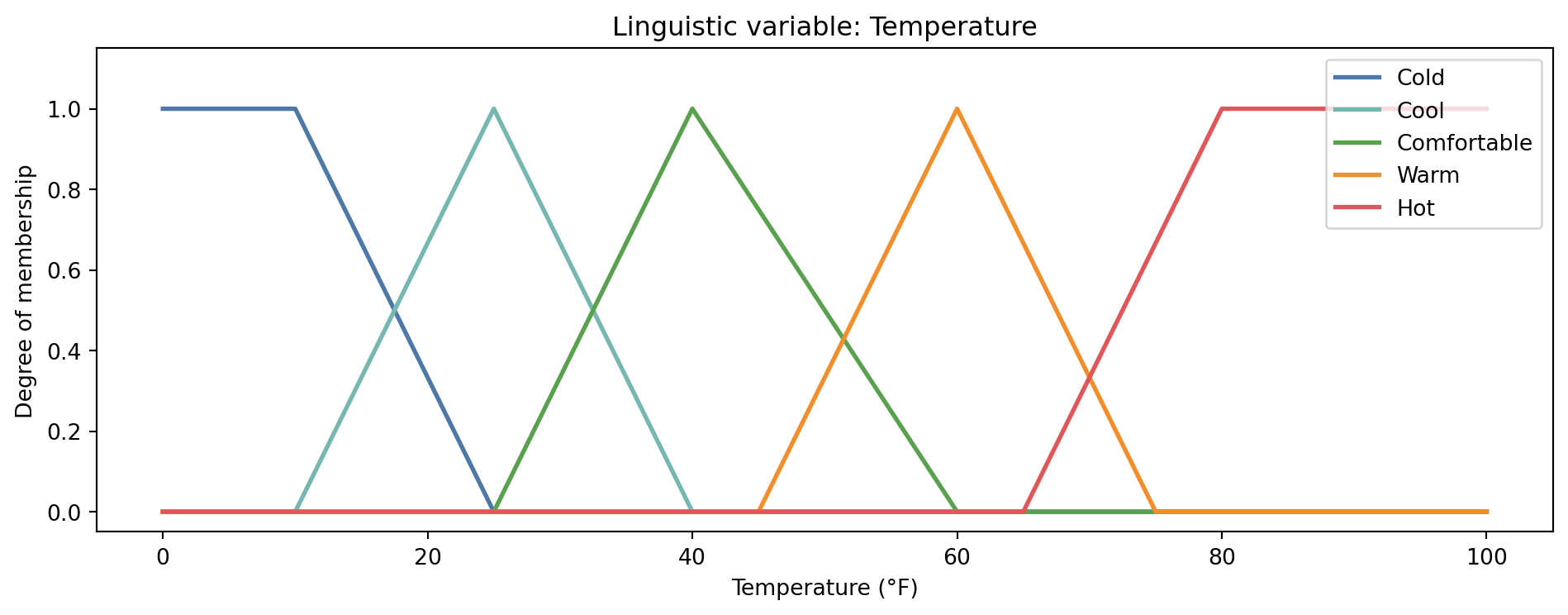
A linguistic variable is a variable whose values are words or phrases in a natural language, each described by a fuzzy set. Temperature might be a linguistic variable with values cold, cool, comfortable, warm, and hot — five fuzzy sets defined over the same numerical domain.
Linguistic variables bridge the gap between human qualitative judgment and numerical computation. An expert who thinks in terms of “the reactor is running hot” can communicate directly with a fuzzy controller through linguistic variables, without translating their knowledge into precise numerical thresholds.
Figure 9.1: Fuzzy membership functions for the linguistic variable ‘temperature’. Each label covers a range with gradual transitions.
9.5 Summary
A fuzzy set generalizes the classical notion by assigning each element a degree of membership in \([0,1]\).
Common membership function shapes — triangular, trapezoidal, Gaussian, sigmoid — are chosen to reflect the semantics of the concept.
Fuzzy set operations (complement, intersection, union) generalize their classical counterparts using \(1-x\), min, and max respectively.
Linguistic variables assign fuzzy set labels to natural language terms, enabling numerical systems to reason with qualitative categories.
9.6 Further Reading
Zadeh (1965) is the original paper — short, readable, and historically important. Kosko (1993) provides a broader and more philosophical treatment. The scikit-fuzzy library used here is well-documented and covers all the material in Chapters 9 and 10.
Kosko, Bart. 1993. Fuzzy Thinking: The New Science of Fuzzy Logic. Hyperion.
Zadeh, Lotfi A. 1965. Fuzzy Sets. In Information and Control, vol. 8.
Source Code
---title: "Fuzzy Sets and Membership Functions"---::: {.callout-note icon=false}## Learning Objectives- Define a fuzzy set and its membership function- Describe common membership function shapes and when to use each- Apply the standard fuzzy set operations: union, intersection, complement- Define linguistic variables and understand their role in fuzzy systems:::## The Spectrum of BelongingIn classical set theory, an element either belongs to a set or it does not. In fuzzy set theory, proposed by Lotfi Zadeh in 1965, an element belongs to a set to a *degree*, expressed as a number in $[0, 1]$.Formally, a fuzzy set $A$ in a universe $X$ is defined by a membership function:$$\mu_A : X \to [0, 1]$$ {#eq-membership}For any element $x \in X$, $\mu_A(x) = 0$ means $x$ is definitely not in $A$; $\mu_A(x) = 1$ means $x$ is definitely in $A$; and any value between means partial membership.A classical (crisp) set is a special case: $\mu_A(x) \in \{0, 1\}$ for all $x$.## Membership Function ShapesThe membership function is a design choice. Several standard shapes recur throughout applications:**Triangular:** rises linearly to a peak and falls linearly. Good for representing "approximately equal to a target value."**Trapezoidal:** flat at the top — a range of full membership before gradual fall-off at the edges.**Gaussian:** smooth, symmetric bell curve. Natural when the concept has a central prototype and uncertainty increases with distance from it.**Sigmoid:** S-shaped. Useful for unipolar concepts like "large" or "fast," where there is no natural peak but a one-sided gradual transition.The choice of shape should reflect the semantics of the concept being represented. There is no universal right answer — the function is a model of human judgment, and different experts may draw it differently.## Fuzzy Set OperationsThe standard operations on fuzzy sets generalize their classical counterparts:**Complement:** $\mu_{\bar{A}}(x) = 1 - \mu_A(x)$**Intersection (AND):** $\mu_{A \cap B}(x) = \min(\mu_A(x), \mu_B(x))$**Union (OR):** $\mu_{A \cup B}(x) = \max(\mu_A(x), \mu_B(x))$These are the standard min/max operators introduced by Zadeh. Alternative t-norms and t-conorms exist (product, Łukasiewicz), each with different mathematical properties, but the min/max versions remain the most widely used.## Linguistic VariablesA **linguistic variable** is a variable whose values are words or phrases in a natural language, each described by a fuzzy set. Temperature might be a linguistic variable with values *cold*, *cool*, *comfortable*, *warm*, and *hot* — five fuzzy sets defined over the same numerical domain.Linguistic variables bridge the gap between human qualitative judgment and numerical computation. An expert who thinks in terms of "the reactor is running hot" can communicate directly with a fuzzy controller through linguistic variables, without translating their knowledge into precise numerical thresholds.```{python}#| label: fig-membership-functions#| fig-cap: "Fuzzy membership functions for the linguistic variable 'temperature'. Each label covers a range with gradual transitions."import numpy as npimport skfuzzy as fuzzimport matplotlib.pyplot as plttemp = np.arange(0, 101, 1)cold = fuzz.trapmf(temp, [0, 0, 10, 25])cool = fuzz.trimf(temp, [10, 25, 40])comfortable = fuzz.trimf(temp, [25, 40, 60])warm = fuzz.trimf(temp, [45, 60, 75])hot = fuzz.trapmf(temp, [65, 80, 100, 100])fig, ax = plt.subplots(figsize=(10, 4))ax.plot(temp, cold, "#4e79a7", lw=2, label="Cold")ax.plot(temp, cool, "#76b7b2", lw=2, label="Cool")ax.plot(temp, comfortable, "#59a14f", lw=2, label="Comfortable")ax.plot(temp, warm, "#f28e2b", lw=2, label="Warm")ax.plot(temp, hot, "#e15759", lw=2, label="Hot")ax.set_xlabel("Temperature (°F)")ax.set_ylabel("Degree of membership")ax.set_title("Linguistic variable: Temperature")ax.legend(loc="upper right")ax.set_ylim(-0.05, 1.15)plt.tight_layout()plt.show()```## Summary- A fuzzy set generalizes the classical notion by assigning each element a degree of membership in $[0,1]$.- Common membership function shapes — triangular, trapezoidal, Gaussian, sigmoid — are chosen to reflect the semantics of the concept.- Fuzzy set operations (complement, intersection, union) generalize their classical counterparts using $1-x$, min, and max respectively.- Linguistic variables assign fuzzy set labels to natural language terms, enabling numerical systems to reason with qualitative categories.## Further Reading@zadeh1965fuzzy is the original paper — short, readable, and historically important. @kosko1993fuzzy provides a broader and more philosophical treatment. The `scikit-fuzzy` library used here is well-documented and covers all the material in Chapters 9 and 10.